
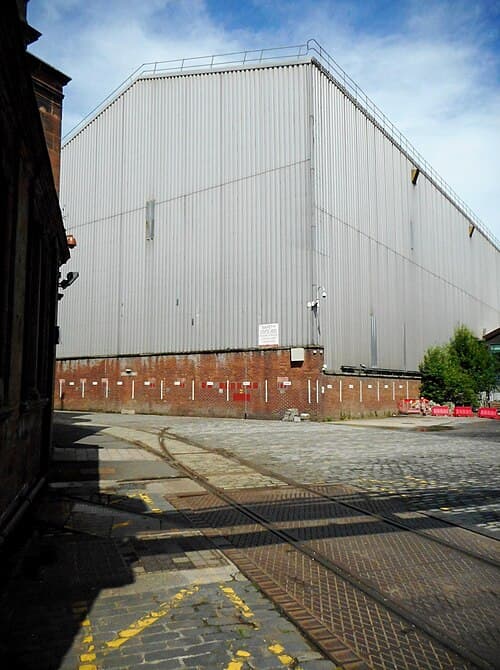
Geograph / CC BY-SA 2.0
At Govan, Fairfield tells how Glasgow and the Clyde built ships for the world, and how that industrial inheritance still shapes the region today.
Fairfield became one of the great shipbuilding and marine-engineering works of the Clyde. John Elder's development of marine steam engines helped make long-distance sea travel more economical, while later Fairfield ships under Sir William Pearce pursued speed, elegance and international markets. The story reaches far beyond the industrial yard itself: machinery and locomotives built across the west of Scotland left through the Clyde for customers and nations around the world, while shipbuilding shaped communities, trade unionism and the working life of the river. Much of that waterfront has since been transformed. Former docklands now carry the SEC on the north bank and the Science Centre and Pacific Quay on the south, while Govan's surviving graving docks are being regenerated for public use, with Dock No. 1 intended to return to maritime repair. Shipbuilding itself continues at Govan today.
The riverside shows us what has survived and changed. The riverside shows us what has survived and changed. The historic Fairfield offices sit beside a working modern shipyard, while directly opposite, the entrance to Elder Park carries the story into Isabella Elder's philanthropy and her relationship with Govan. Nearby, the Govan Graving Docks preserve the physical scale of the old maritime infrastructure, while further upriver the Stobcross Crane still marks the place where heavy Glasgow-made machinery was loaded for export. Across the Clyde, former industrial land now carries some of the city's most recognisable modern buildings.
There are three pillars of Govan: the Elders, the Pearces and the people. Their shipbuilding story is one of a broader industrial heritage that is written across greater Glasgow. Some of it survives directly in Govan, where ships are still being built and the old graving docks are beginning another life. Elsewhere along the Clyde, former docklands have changed completely in character, with the SEC on one bank and the Science Centre and Pacific Quay on the other. Then you have the Stobcross Crane still standing over the Clyde, where Glasgow-built machinery and locomotives were loaded for export. The wider Clyde industrial story reached even further: Clyde yards built ships and warships for customers around the world, including Japan. For me, it makes industrial history feel much less like something that has disappeared.
Ask about exploring this place or connecting it with others on a guided day in Scotland.
Shaping a private day around what interests you
Whether you are drawn to traditional crafts, industrial history, or dramatic Highland landscapes, Ross shapes private journeys around your interests and pace.
Get in touch